by Stefani Ruper | Nov 23, 2015 | Body Image, Self-love |
The following post is a guest post by…. you guessed it! The world famous and super fabulous body-image expert Summer Innanen. And she’s got a brand new book out that’s available for FREE on the 27th… read to the end to get a link for it!
When you’ve struggled to have a positive body image, it can be difficult to feel optimistic about getting to a point where you love yourself. As someone who spent most of her life hating her body and measuring her self-worth by her jean size, the idea of loving myself seemed completely far-fetched. Feeling comfortable in my own skin was a state of being that I’d never experienced.
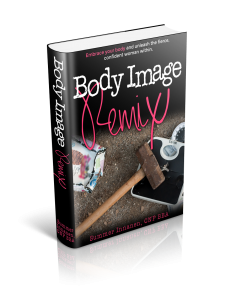
Years later (with lots of self-discovery and support!) I can truthfully tell you that I rarely think anything negative about my body anymore. I don’t compare myself to other women. I don’t let my body hold me back from wearing clothes that aren’t “flattering.” I no longer seek others’ approval to build my self-worth. Through this process and helping other women to do the same, I’ve learned so much. I want to share some of the things that I wish I’d known when I started this journey – these are excerpt that are pulled from my book Body Image Remix.
Here are 5 must-know things about self-love.
- What self-love really means.
Contrary to what certain body wash companies might have you believe, loving yourself doesn’t mean you walk through a door that says “beautiful”. We misinterpret self-love as meaning we’ll wake up and wink at our reflection in the mirror everyday. While it’s great to have moments where you feel sexy (and you certainly deserve it!), I want you to know that embodying self-love is so much more than this.
At its core, having a positive body image is about having unconditional love and compassion for yourself. It’s about knowing ourselves, showing up as ourselves, and treating ourselves with trust, respect, and kindness. It’s about knowing that we’re enough just as we are – even if we don’t like every part of ourselves. Focus on treating yourself with the utmost kindness and respect, regardless of your appearance, and you will find peace of mind much more readily.
- It’s about your beliefs.
When I ask women what they struggle with when it comes to body image, they always mention parts of their body that they “hate”. Your body is not what you struggle with in reality. What you struggle with is the negative voice in your head that is telling you there is something wrong with you. Changing your body is not going to make that go away.
While your self-loathing may dissipate momentarily if your body shape changes, it’s generally a false sense of validation that is not intrinsic or long-lasting. Unless you deal with the beliefs inside your head, thinness is not going to be the catalyst to your self-love. This change needs to come from within, and you get there by changing your mindset. A huge piece of cultivating positive body image is about identifying the beliefs that are holding you back, challenging them and choosing new beliefs that will support you moving forward.
- It’s not an overnight process.
Self-love is a complex masterpiece and it requires patience. It is not a diet. There’s no immediate payoff. If you have been buying season tickets to the crash diet mayhem in our culture, you might tend to expect big changes in short periods of time. Cultivating self-love happens in the complete opposite way—it consists of so many different layers, inputs, and outputs. There are huge rewards, believe me, but they are often less tangible and not always immediate. Patience is extremely important in this process.
The journey to self-love is the furthest thing from linear and it’s definitely not the shortest distance between two points. Some days, you might feel like you’ve taken three steps forward and then five steps back. Sometimes, you might feel a euphoric sense of peace, and all seems right in the world. The beauty of this journey is that with each setback, you learn more about yourself. You appreciate how far you have come and become better equipped to surf the rough waves in the future.
It’s impossible to jump from hate to love, so celebrate every step you take along the way.
- It’ll feel scary and that’s a good thing.
I want you to get in touch with what you want in life by loving yourself—to feel more confident in social situations? To hit the beach in a bathing suit? To walk past a mirror without doing a stomach check? One of the things I encourage women to do is to start doing the things they have been avoiding in the body they have today. Whatever it is for you, I guarantee there is a level of fear that rises to the surface when you think about doing those things. Usually this fear is rooted in, “OMG, what will people think of me!” It’s critical to recognize that this is the good kind of fear. This is the kind of fear you want to link arms and dance into the sunset with.
Here’s the truth: Loving yourself and showing up to this party know as life as your true self takes serious guts and is the ultimate act of rebellion in a society that tells you who you should be. That means it’s going to feel scary to do the things you’ve been avoiding. Accept and lean into this fear knowing that every time you take action, it will get easier and ultimately it’s going to lead you to a more freeing and joyful existence.
- Compassion over confidence.
On the heels of that last point, stepping into your fear and faking it until I make it is only one piece of the puzzle. We don’t always need more confidence; what we really need more of is compassion.
Confidence is the courage to show up as the woman you want to be today. Compassion is the capacity to embrace imperfection and be OK with the outcome, no matter what happens. One of my favorite unattributed Pinterest quotes is: “Confidence is not ‘they will like me,’ it’s ‘I’ll be OK if they don’t.’” Where this quote falls short is that confidence doesn’t actually help you to be OK if they don’t—compassion does. Compassion helps us to forgive and be kind to ourselves and is all about the ability to relate to yourself with kindness. If you’re relating to yourself in a harsh, disrespectful, or unkind way, it’s time to change that. Being gentle, kind, forgiving, and understanding to yourself via compassion is the most important skill to master in order to foster self-love.
If you’re ready to get on with the life you’ve been putting on hold and stop letting the scale, your jean size, dietary macros and Fitbit points dictate your self-worth, then get the book Body Image Remix for free when it releases on Friday November 27th here.
Summer Innanen is a Certified Nutritional Practitioner and Body Image Coach. She helps women all over the world to ditch their diet demons, amp up their confidence, and break free of chronic dieting and guilt through her private and group coaching at
summerinnanen.com. She is the author of Body Image Remix, creator of the 21 Step Body Image Remix program and host of
Fearless Rebelle Radio, a podcast dedicated to empowering women to live life on their own terms.
--------
So, just as a heads up - some links above may be my affiliate links, which means I get a small commission if you click on it and make a purchase. Doing so is no additional cost to you, but helps me tremendously. Your support is SO greatly appreciated, so thank you in advance if you choose to do so. Check out my entire disclosure to know exactly how things work.
by Stefani Ruper | Nov 12, 2015 | Body Image, Love, Self-love, Sex, Sex & Relationships |
Today is a day for ranting.
Today is a good day.
Here we go.
…..
Have you ever heard someone say “the female body is so complicated?”
Have you heard female genitals referred to as complex, mysterious, strange, alien, or elusive?
Have you ever heard the female orgasm described as “impossible” in large part because “it’s just more difficult to make it happen for women than it is for men”?
Perhaps you have heard the female body described this way your entire life, so none of this seems strange to you?
This is exactly the case for nearly every woman and girl in America today.
Today, we live in a world in which the female body is a “mystery.”
It’s complex. It’s elusive. (By the way, if you can get it to orgasm, you are a hero.)
Most people probably just basically think these sorts of statements are true. “Sure,” you may say. Of course that’s true. It just makes sense.
And even if people think that this whole mysterious idea is incorrect, it’s likely that they don’t find it problematic. So they don’t care all that much. What’s the big deal? Who cares if the female body is thought of as mysterious or not? Should anybody care? Does anybody care?
This girl does:
And she cares a lot. Here’s why:
The Myth
I believe that “female complexity” – especially with regard to genitals – is a myth.
I believe we have constructed this myth over the course of centuries and decades. Throughout Western history, men have been considered normal. But women have been abnormal, deviant, tempting and even devilish. (Trust me, I study religion for a living.) Men have been the status quo. Women have been The Other.
Men’s bodies have been acceptable, and women’s bodies have not. Men’s bodies have been studied extensively and treated well, and women’s bodies have not. Men’s bodies have been applauded for their ability to rape, dominate, and insemniate, and women’s bodies have not.
Moreover.
Men’s pleasure has been and today continues to be thoroughly studied, advocated, and glorified. Think of all of the pop culture references to oral sex performed on men. Think of ‘milk shakes’ bringing all the boys to the yard. Think of Christina Aguilera in Eminem’s Slim Shady and who she gave head to first.
Think of all the drawings of penises you see scribbled over journals, lockers, graffiti walls, and even people’s faces when they pass out drunk. Think of being asked to join the “pen 15” club when you were in junior high school. Think of the way in which it is acceptable to say “penis” in public, but everyone kind of lowers their voice when they say “vagina.”
Think of all the Cosmo articles about how to please your man. Think of the expectations placed on your ability to perform oral sex on a man, starting from a young age. I very, very clearly remember a good friend of mine disappearing behind a factory with a boy to pleasure him when we were twelve years old. Twelve! She did not receive sexual attention from a man in a loving manner until years later. I also remember the high amount of pressure placed on me and my girlfriends as we began journeys into sexuality and adulthood, and needed to give our partners oral sex or else we were prude. I am by no means saying that the way we behaved was awesome. Nor am I saying that we need to stop teenagers from being sexual. Not at all. Neither is the case.
But what I am trying to demonstrate is that in our culture, male pleasure is very significant, and the male reproductive organs are much more acceptable than the female.
Nowadays, our culture is definitely less skitish about female pleasure, don’t get me wrong. But that doesn’t mean any significant battles have actually been won.
Deconstructing the myth
I believe that the whole idea that the female body is sooooo complex guys omg arises out of our culture’s attachment to and acceptance of male pleasure. It is a fabrication. It is a lie. It (subconsciously) justifies our persistent denial of female sexual equality and needs.
And it needs to stop. Now.
Imagine, if you will, a culture in which the female sex was dominant.
Is it not easy to reverse the roles? Is it not easy to imagine vulvas scrawled on subway doors, lewd pop culture images of men pleasuring women, and penises shunned as abnormal and complicated to please …. whereas vulvas are celebrated for their simplicity and ease for pleasuring?
Consider a diagram of each the male sexual organs and the female sexual organs.
If you remove as many mental biases as you can, can you not perhaps see that the penis and the vulva are actually not all that different? That they are actually not all that more simple or complicated than one another? In fact, the general anatomy of these two structures is the same, and made out of the same tissue! A clitoris is simply a small version of a penis – or, a much better way to put it: a penis is simply a large version of a clitoris. Lips are the female equivalent, more or less, of testes. And then there is a vagina, in which a penis can go. The female anatomy is not a huge mysterious complexity. It is not. It simply is NOT.
We only think it is, because we have been told it is.
I invite you then to think about what it takes to sexually pleasure male or female genitals. In our culture, we always say, “it’s so easy to please a man” and “so hard to please a woman.”
But please. Excuse me. At least you can breathe when you perform oral sex on a woman. You cannot always really do so when you perform oral sex on a man, because there is oftentimes a large object in the way of your wind pipe.
And is it all that more “simple”?
No! It isn’t. (And I can say this, I really can, with experience, because I have sexual relations with all genders.) The penis has good erogenous zones and bad ones, just like the female genitalia do. And it can be approached in many different complex ways, just like the female genitalia. Some people like some actions, and some people like others.*
Period. End of story. Everybody has preferences. It’s not just women.
We think women are harder to please because we have come from a history of shunning the female body.
Now: it may be slightly easier to bring a man to orgasm, especially young men (seriously, wow)… BUT data collected in hospital studies actually tells us that when women and men masturbate, it takes them the exact same amount of time to orgasm.
This fact is alarming, because what it means is that we have literally convinced ourselves that women cannot orgasm simply because (many) guys simply don’t want to make it happen…
and used something like “but female genitalia are so complicated!” as an excuse.
Guess what, everybody.
Not that complicated.
Broader implications
You might think then… so what?
“I don’t care all that much about sex.”
“I don’t care all that much about physical pleasure.”
Well, to be honest with you, I don’t either.
But I care about this so deeply because it is a part of an underlying problem:
when women are ignored, denied, mistreated, or misunderstood sexually, it means that they are being ignored, denied, mistreated, and misunderstood in other realms, too.
None of it is separate from anything else. Our culture’s attitude towards women permeates all aspects of our lives.
Because we do this. We think that women are mysterious.
Men are simple, we say. Women are complex!
Men are rational. Women are emotional and impulsive.
Men are straightforward. Women are circular.
Men are sane. B*tches be crazy.
These things are all very real, and very problematic.
So what do we do about it?
Chipping away at one specific angle of gender misconceptions at a time – and especially one as emotionally charged as sex organs – will go a long way toward making a more equitable, compassionate and empathetic future for the sexes.
I really believe it will. I do, I do.
-We get more open (pun unintended but awesome) in general about the vagina and the whole vulva.
-We become more comfortable with the words themselves. Vulva. Vagina. Clitoris. Vulva. Vagina. Clitoris.
-In fact, we make a point to emphasize the words ‘vulva’ and ‘clitoris’ because ‘vagina’ – the one that’s most well-known – is only the most famous one because it’s the part a man puts his penis in.
-We teach those words to young people as easily as we do other sexual terms.
-We have discussions with our lovers about how to please us. We don’t expect that people just know. In the culture we live in especially, that’s just not in the cards. It’s not necessarily fair. So we have to communicate openly and lovingly with our partners about what works for us and what doesn’t.
-We stand up for our right for sexual pleasure, along with all other kinds of reciprocity and empathetic treatment.
-We talk with young boys and girls about gender dynamics, and the history of gender imbalance.
-We educate young people about the physiology of both male and female bodies equally, and do not do so with language that discourages comfort with the female body.
… and that’s all I’ve got for ideas for now.
Do you have any ideas about what we can do?
Please let me know! I feel very strongly about this (not like that wasn’t obvious)….
So any input you have would be great!!
Finally, take a look at these three awesome books, which are the cornerstone of my sexual know-how and a big part of the reason I wrote this blog and feel this way:
And this post:
*The fact that we call the penis “simple” in fact I think has been detrimental to male pleasure, too – because it stops hetero women and queer men from treating this organ with the detailed attention it deserves.
--------
So, just as a heads up - some links above may be my affiliate links, which means I get a small commission if you click on it and make a purchase. Doing so is no additional cost to you, but helps me tremendously. Your support is SO greatly appreciated, so thank you in advance if you choose to do so. Check out my entire disclosure to know exactly how things work.
by Stefani Ruper | Nov 12, 2014 | Blog, Body Image, Love, Self-love, Sex, Sex & Relationships |
Somewhere in the neighborhood of 40 percent of women report having “sexual dysfunction.”
This was, for me, on first encounter, an astounding statistic. That’s practically half of us women!
Yikes!
Upon further reflection, however, the statistic makes perfect sense to me. To be honest, I’m surprised the number isn’t higher. With such high rates of negative body image, obesity, eating disorders, depression, anxiety, and stress in female lives in America, not to mention all the sexual objectification and denigration that happens in culture at large… it seems as though almost none of us should be getting by unscathed.
There are plenty of physiological reasons libido can be off, and plenty of ways to troubleshoot that with diet and lifestyle changes . You can also read my book “Sexy by Nature”which addresses all of this and my thoughts on it here.
Perhaps even more important than that, however, are psychological problems. Psychological problems, ranging from doubts about your body’s appearance to lack of trust in your partner, cause undue worry in the female brain during sex. If your brain is anything other than 100 percent relaxed and “in the moment,” it’s going to be much harder to enjoy yourself and orgasm is going to be approximately 1500000% harder to achieve than otherwise. This is a simple fact of female physiology.
These are these psychological roadblocks to satisfying sexual activity I see most often in my friends and clients (and please note, before reading ahead, that I use explicit language and talk about explicit sexual things, so if that isn’t your cup of tea, feel free to stop now, no hard feelings. 🙂 ):
1) Thinking your lady parts are “gross”
I remember being twelve years old on the way to dance practice in the back of my mother’s SUV being told by my “cool” friend that I needed to shave my pubic hair if I wanted to be sexy.
I also remember experiencing feelings of disdain for this friend, since I obviously already knew that.
I also remember making jokes about vaginas smelling badly, and tasting badly, and being all around just horribly unpleasant.
This made me never want to inflict my body on anyone. If my vulva were so gross, how could I possibly expect any man or woman to enjoy it? If they insisted on pleasuring me anyway, how could I be sure it was because they really wanted to? What if they were grossed out the whole time?
Okay, ladies. This is the most important lesson about our sexual selves I think we could ever learn:
There is no valuative difference between a penis and a vulva. No smell, taste, sight, or feel of one is better than the other. Neither are “gross.” Any person or any media like a movie (or porn) that leads you to believe so is not just wrong but possibly evil.
If you want to read what our partners (and men in particular) REALLY think about the vulva, its taste, its smell, and what they are really thinking, you’ve got to read “She Comes First” by Ian Kerner. It will open your eyes!
And if your partner is one of those evil doers, it’s time to have a conversation about what’s going on, or to show them the door. This is not a joke. Your body is straight up awesome. It has the ability to give both you and your partners pleasure (here for male pleasure, here for female!). It is a wonderland. No one has the right to take that away from you.
You are not gross. Society’s double standards about the impurity of female bodies has only made you feel that way.
2) Feeling self-conscious about the way your body looks
If you’re laying in bed and trying to think of sex positions that can hide your rolls rather than enjoying the ride, that’s a giant road block to both connection with your partner and also physical pleasure.
Nothing kills a libido like self-doubt.
Fortunately, there’s a fantastic remedy to this problem. It’s remembering three simple facts:
1) The sexiest woman alive to any person having sex is the one right there in the bedroom with them. Sure, Jennifer Lawrence may be a physical specimen, and Giselle Bundchen may have “perfect” proportions, but neither of them are a real person with your real partner in a real room.
2) Nobody will get into bed with you if they find you unattractive. Period. Initiating or consenting to the sexual act means that this person wants to be there. So get out of your own head. Stop worrying about the way that you look. This person finds you sexually appealing for one reason or another – there’s absolutely no way to ignore this fact.
3) The last thing any person you’re sleeping with wants you to be doing is worrying. That’s ridiculous. What they want is for you to be thinking about them and having a good time. So do those things. Don’t disrespect yourself or your partner by being self-conscious. Trust your partner’s desire, own every inch if who you are, and let yourself move comfortably in your own skin.
I know letting go of self-consciousness in the bedroom is easier said than done, but it’s incredibly empowering. Plus, once you begin doing it, you can’t stop. Self-love is powerful, and infectious.
3) Feeling ashamed of sexual desire and activity
As women in American society, we are taught (if subconsciously) that we are dirty and immoral if we have sexual desires. We are told that our bodies are primarily objects of sexual desire. Men want us, but we don’t want them. Men lust for us, but we don’t lust for them. Men always have orgasms, women sometimes do. Men’s sexual desires are supposed to be robust and lusty – marking them as strong “men.” Women’s sexual desires are supposed to be shrouded in burkas and locked away beneath chastity belts.
Mark my words, however:
this is bullshit.
Women have every right to be sexual, just as much as a man. Women are free to have desires – even non-monogamous ones! – and to have them be pleased. (My FAVORITE book on that topic is this one, you’ve got to read it!)
I cannot tell you how many women I’ve spoken to who have never had an orgasm in bed because it just “wasn’t her place.” So many women are focused on pleasing their partners, and keep quiet about their own needs.
In American culture as a whole, we tend to radically favor the male orgasm in bed, and to deny the importance of female pleasure.
But this is wrong. Your needs are normal. They should be met as equally – whatever they are! – as your partners are. You should be in the bedroom to take care of and entertain each other, not for you to be a subservient, unfulfilled sex toy.
So – if your sex life is unbalanced, consider if that’s because of your partner’s attitude, or your own. Consider why you neglect your own pleasure. Challenge yourself to accept this part of yourself. Challenge yourself to be in conversation with your partners about this. You will never get to experience pleasure if you do not welcome it into your heart.
4) Not having a safe space in which and partner with which to be sexual
This almost goes without saying. If you don’t trust your partner, like your partner, or have pleasant sexual experiences with your partner, you will never feel comfortable in bed with your partner.
If you do not feel comfortable, you will not have an easy time experiencing physical or psychological pleasure.
The solution to this problem is entirely contingent on your own particular situation. Perhaps you need couple’s therapy. Perhaps you need to have a conversation about each other’s doubts and desires. Perhaps you’re in an irredeemable relationship that you need to get out of. Perhaps you pick up random strangers who don’t always treat you very well. Perhaps you and your partner simply need to remember how to laugh with and love each other.
5) Worry about your sexual skills
Lots of people spend all of their time in bed worried that they’re not doing it “right.”
The only way to know if you are or not, however, is to ask. Every person is different, and every person has different tastes and desires. You’ll never know if what you’re up to is good for your partner if you do not communicate about it.
Moreover – the most important aspect of “skill” in the bedroom is the willingness to experiment, to listen, and to give and receive feedback. It’s not about how many partners you’ve had or how many sutras you’ve practiced. It’s about your desire to give pleasure and experience connection, and to communicate. Don’t worry about your performance. Simply be, and talk, and ask questions if you want answers.
There are two books that I really like that can also help with the concrete skills of sexual performance as well. Find them here and here.
6) Being too stressed to think about sex
Any thought that takes you away from your partner is going to diminish the quality of your sexual experience. This is true for all people, but it is especially true for women. Your body craves sexual activity only if it perceives a great enough state of safety in your life to enjoy it.
Stress makes you dwell on problems and prevents you from delighting in the blessings in your life.
The best way to mitigate this problem is to reduce the amount of stress in your life. This liberates your day dreams to wander into the realm of the explicit and the naughty, and it makes your heart free to reflect on love. If you absolutely cannot eliminate certain stressors, do your best to set aside time for sexual activity. When you do so, check your worries at the door.
Give yourself the time and space you need to be fully present – not locked in the past nor anxious about the future – and the depth of connection and pleasure you and your partner both experience will skyrocket.
But what does any of this have to do with paleo?
As I’ve argued many times before, there is the paleo diet, on one hand, and then the paleo perspective on the other.
Paleo provides us with a lens with which we can examine our lives. At least this is how I like to look at it. Paleo asks us to question social norms, and to think deeply about where our beliefs and habits come from. Just about everything we think, say, and do is cultured by the world in which we grow up. It is helpful for us to analyze those things (I do a lot of that in my book!), so that we can do away with the unhealthy ones.
Thinking a woman’s body “gross,” for example, is one of those things.
Paleo also asks us to think about what is “natural.” Is it natural to have sexual desire? Natural to have an imperfect body? Natural to receive pleasure without feeling guilty? The answer is yes to all of these things. Thinking about humanity in evolutionary terms helps us see that. Many groups – such as the evangelical Christian sects that promote purity vows in young girls – don’t think much of evolution, and this ends up being a significant hindrance to healthy and happy sexual activity.
(My favorite book on the naturalness of sexuality and questioning social norms [not my own!] is this one.)
Sexuality is an important part of relationships and life. There are physical aspects of that – which the paleo diet certainly helps, as I’ve discussed at length here – and there are psychological aspects of that which are also fun and important to look at with an evolutionary lens.
--------
So, just as a heads up - some links above may be my affiliate links, which means I get a small commission if you click on it and make a purchase. Doing so is no additional cost to you, but helps me tremendously. Your support is SO greatly appreciated, so thank you in advance if you choose to do so. Check out my entire disclosure to know exactly how things work.
by Stefani Ruper | Aug 28, 2014 | Blog, Body Image, Self-love |
Regular readers of this blog and my books may have an inkling that I am a proponent of self-love.
An inkling.
Or something.
…
Just kidding. Have you read Sexy by Nature?? I do almost nothing on the internet other than teach people how to love themselves.
Today I bring this discussion to you in a 30-minute how to video, replete with my ten favorite tips. (Which are related to, but different from, the “10 Reasons to Love your Body” Youtube video I’ve got floating around the paleosphere.)
In this new class I share struggles and triumphs of my own life, what I loved so much about therapy, and how to stand up for yourself in the face of all that’s trying to keep you down.
The talk is located over at the Entheos Academy for Optimal Living (which I adore).
Click here to jump to the site and view!
Here’s part of the list of the ten ideas I propose:
-
Surround Yourself with the Love You Deserve
(Before you improve your brain and heart, optimize your environment for success.)
-
Deconstruct
(Before you can build a shiny monument, you’ve got to knock down the crumbly, decayed pillars.)
-
Appreciate
(Chances are infinitely good that no matter how many failures you perceive in your body, the things it does right vastly outnumber the wrong.)
-
Lessen Your Attachment to Your Looks
(Wherein Stefani tells you you are awesome for many reasons and you need a healthy body in order to be so. Here are my thoughts on women’s health and how to lose weight healthfully if you’d like to.)
-
Set Realistic Expectations
(Perfect just ain’t real.)
-
Get Embodied
(Practice being in harmony with your body by doing awesome things like dancing.)
-
Fight
(Get fierce! Say no to norms and yes to love.)
…and more. (I’m simply not sharing all of them and in full because there may be copyright issues involved?)
Read the full list of self-love tips and explanations, watch a trailer of the video, and watch the complete 30 minute video at the Entheos Academy for Optimal Living here. And while you’re at it, check out Sexy By Nature for more of my thoughts on how you are the most awesome!
—–
While we’re at it, I may as well tell you about what a stellar, life-changing business the Academy for Optimal Living is. (At least in my experience.) It’s basically like Netflix for your brain and your soul. You sign up (there’s a good-length free trial)-and receive access to hundreds of classes on topics ranging from the proper interpretation of Nietzsche to how to fuel your body as a triathlete. Their tagline is “optimize your life. change the world.” Awesome, I know, and I am so honored and grateful to be considered a “Professor” (alongside people like Abel James and JJ Virgin) and a “thought leader in the field of women’s health” by these giants of wisdom, and even happier to be able to take their classes.

--------
So, just as a heads up - some links above may be my affiliate links, which means I get a small commission if you click on it and make a purchase. Doing so is no additional cost to you, but helps me tremendously. Your support is SO greatly appreciated, so thank you in advance if you choose to do so. Check out my entire disclosure to know exactly how things work.
by Stefani Ruper | Jul 22, 2014 | Blog, Body Image, Disordered Eating, Self-love |
The following post is by one of my absolute most beloved health professionals in the paleo scene, Summer Innanen. You can read all about Summer in her bio at the end of the post. Suffice it to say for a brief introduction now, however: I loved this list she drew up. It helped me. Forgive her Canadian spelling. She’s smart. Listen.
Also, after you read this post I am sure you will be as enamored with Summer as I am. She has an incredible program which I happily promote called the 21 Day Body Image Remix. This program will help you rock your body, develop radiant self-confidence and just generally be a badass! Check the program out here.
And while you’re at it, don’t forget to check out my book Sexy By Nature for my thoughts on soaring self confidence, women’s health, and being the best version of you! Find it on Amazon here.
——
One of the most important components of cultivating self-love is changing your self-talk. We do this by censoring the negative criticisms that we so often slander ourselves with, both consciously and subconsciously. However, these negative criticisms can manifest in ways that you may not be aware of.
In our culture, it’s perfectly acceptable to defame yourself in front of others. In fact, it seems totally normal to say something like, “I’m so fat”. However, if you say something like, “I look sexy in this swimsuit”, you are considered conceited or a bitch. [Stefani comment: yikes!] It’s no wonder we are so quick to put ourselves down.
The first step to changing your self-talk is by being aware of when you say these things and eliminating negative statements from your internal and external dialogue. Statements such as “I’m so stupid” or “I look so gross in this outfit” are harsh words of self-hate. When you stop saying them, you begin to stop thinking them and can more easily reprogram the feelings about yourself. We have the power to change our beliefs and thoughts, which is a powerful mechanism when it comes to feeling sexy and confident as the woman you are today.

Via summerinnanen.com
The second part of this equation is to censor negative judgments and criticisms of others. As a culture, we seem to tolerate and even find humor in shaming other women about their appearance, their habits and the way that they do things (ranging from criticizing a woman’s driving to the way she raises her children). The areas that we are quick to criticize and judge others are usually areas where we feel vulnerable ourselves. We use this as a way to make ourselves feel better, however doing so only feeds our insecurities and feelings of unworthiness.
The judgments we make of ourselves and others can manifest in less obvious ways that you may not be aware of. It’s important to recognize the various things we do that feed our insecurities in order to deconstruct our core issues and foster self-love, while promoting a culture that no longer considers it acceptable to put other women down.
Here are 5 less obvious habits that we have, which prevent us from cultivating self-love:
#1 – Deflecting Compliments
How many times have you deflected a compliment from someone? A friend tells you that you are beautiful or talented and you reply by negating it or blowing it off. We do this because we feel that it conflicts with the way we feel about ourselves or that the person didn’t really mean it because you don’t believe it.
Rather than deflecting a compliment, simply say “thank you”. Then use this as an opportunity to reflect on why your initial urge was to react by denying it. As long as you continue to deflect or deny compliments, you will perpetuate negative feelings about yourself.
#2 – Changing Your Actions
We often change our actions in response to our fear of being judged. We order a different item on the menu when we are out on a date. We set up our yoga mat in the back corner so no one can see us. We put on makeup before going grocery shopping because we want to appear more put together. We put three layers of self-defense over our bathing suit so people can’t see our ‘flaws’.
The reality is that you cannot change or control other people’s perceptions. You also don’t need anyone else’s approval or acceptance in order to love yourself or feel worthy. In fact, if you rely on gaining approval to feel worthy, you will never actually love yourself.
It’s important to practice being more real and owning your uncool self. Be willing to fall over in yoga class, eat a burger and fries with your hands on a date (if that’s what you want to eat) or show up with your hair out of place. Make every effort to show up as yourself and never change your actions based on your fear of being judged.
If you feel yourself resisting this task, then ask yourself why. It’s important to use these moments as a cue to dig deep and think about why you feel this way. Also, know that you are not alone and women feel this way all the time!
#3 – Seeking Validation
Many of us are perfectionists who seek out approval and validation from others in order to feel worthy. However, this prevents us from feeling worthy because we cannot control the way other people view us. We need to love ourselves first before we can receive love from others.
Pay attention to whether your words or actions are the result of a need for validation. Do you put yourself down in order to receive compliments? Do you rely on social media ‘likes’ to feel better about yourself? It’s OK to enjoy being validated and receive compliments, however this should not be used as a primary vehicle for self-love.
#4 – Comparing Down
We look for people who we perceive as ‘worse’ than us in order to feel better about ourselves. For example, we feel better at the beach because we are not the ‘fattest’. We feel better at the gym because we didn’t ‘finish last’. We feel like we have more self-control because we didn’t eat dessert. This is ridiculous!
This only feeds a cultural standard where judgments are acceptable and promotes our reliance on what other people may think in order to grow our self-worth. Work towards eliminating your desire to compare down in order to feel better about yourself.
In addition, practice being more vulnerable and willing to be the person who ‘finishes last’. Celebrate your imperfections and own the person that you are today.
#5 – Creating Excuses And Apologizing For Your Actions
How many times have you apologized for something that you actually could not control? Our apologies act as a buffer that prevents us from thinking that the other person may be judging us negatively. We apologize before they can think something negative about us (which they usually never are).
Stop apologizing for things that you could not control. Unless you legitimately did something wrong (like knock over a kid’s juice box), there is no need to apologize.
We also tend to make excuses before we do something to protect us from other people’s judgments. For example, before we are about to do a presentation at work we say, “I haven’t prepared for this at all” or “I didn’t sleep last night, so I’m not sure how well this is going to go”. We set the bar low to protect us from other people’s scrutiny or to seek validation. Both of these things imply that we are not good enough, which fertilizes the negative feelings we have about ourselves.
As you practice self-love in your everyday life, it is imperative that you begin to bring awareness to the various ways that you continue to hold yourself back.
I challenge you to commit to 7 days of censoring these habits. Bring awareness to your negative self-talk (in all of the aforementioned ways that it can manifest) for one week and you will start to realize how much this permeates in your life. From there, you can start to deconstruct the rationale behind your negative self-talk in order to move forward.
Not only do we need to do this for ourselves, but we also need to shift these types of behaviors and conversations amongst our peers. The reality is that we cannot control other people’s actions or perceptions, but we can make every effort to change our culture by leading by example.
——-
So now that you have figured out the AMAZINGNESS that is Summer, check out her 21 day Body Image Remix here. And don’t forget my bestseller, Sexy by Nature!
Awesome, right? Let Summer know in the comments!
Bio
I’m Summer Innanen, Certified Nutritional Practitioner and Body Image Coach, specializing in emotional eating. More importantly, I’m a diet rebel and food lover on a mission to help you feel hot-damn fearless in your body. I roll with straight-talk, tough love and wicked humour to help women all over the world with my one-on-one and group programs. I empower women to ditch their diet demons, rock their bodies, and start caring about things that actually matter (like grabbing your dreams, spoiling yourself silly, and remembering how holy-powerful sex makes you feel). Check out my podcast Fearless Rebelle Radio and connect with me on Facebook, Twitter, Instagram and Pinterest. If you’re ready to break the rules, grab your sledgehammer and get my free guide here.
The featured image is a photo of Summer, thanks to SarahRamsden.com.
--------
So, just as a heads up - some links above may be my affiliate links, which means I get a small commission if you click on it and make a purchase. Doing so is no additional cost to you, but helps me tremendously. Your support is SO greatly appreciated, so thank you in advance if you choose to do so. Check out my entire disclosure to know exactly how things work.
by Stefani Ruper | Jul 10, 2014 | Blog, Body Image, Disordered Eating, Feminism, Self-love |
Loving your body is one of those things you are supposed to do. You are supposed to cherish it. You are supposed to appreciate it. You are supposed to enjoy looking at it in the mirror. We are all supposed to do these things. Hell, I’ve written a whole book on them. Have you read Sexy by Nature?
Right? I’ve worked on body love so much I even know how to help you do it.
I do.
From all of that experience, I know that there are good ways to do it, and there are bad.
I (obviously!) do it all the good ways. I love my body because of what it does, and because of gratitude for what it provides to me — like the abilities to breathe, and to laugh, and to be happy. I love my body because it is my home. I love my body because it does its best to make me healthy. I love my body because the number of things it does right far outweigh the number of things it does wrong. I do not love my body based on shallow, transient characteristics like the circumference of my abdomen or the semi-linearity of my almost-white teeth. (I do, admittedly, really enjoy having orange hair.)
I love my body in all the right ways and for all the right reasons.
——-
Yet…
(there’s got to be a “yet,” right?)
Yet.
Sometimes I do not love my body.
Sometimes, in fact, I hate it.
Sometimes I fear it.
Sometimes I resent its limitations so fiercely I dig my nails into my mattress and sob until I run out of breath.
Here is why:
My body works, but not the way it is supposed to.
My body sleeps, but never for more than four hours at a time and sometimes not at all.
My kidneys process potassium, but at a much lower rate than other peoples’ do.
My heart beats, but faster and harder than a healthy heart beats.
My skin protects me from the outer world. It looks pretty good these days. But one sweaty workout, one bite of vegetables fried in butter, one handful of nuts, one small period of fasting, one ten-minute exposure to UV rays, and I will most certainly have acne the following morning.
My eyes work, but are photophobic, which means that I get migraines from any lights brighter than a desk lamp. I always wear sunglasses outside, and sometimes I even have to wear them inside. This is not a whole lot of fun in ballet class.
My metabolism burns, but slowly. Just one “off” day and my pants are noticeably tighter. If not careful, I’ll put on five pounds in a week.
My ovaries now work better, thanks to serious efforts and healing on my part, but I also experience weight gain and quite depressing PMS like clockwork every 27 days.
My muscles contract, but those in my back more than other people’s, which means I get headaches if I have poor posture or sit down for too long.
My eardrums are great at detecting quiet sounds. Their sensitivity can be helpful. It can also be oppressive, since loud sounds and pressure from the wind give me headaches. I always have a pair of ear plugs on me in case I need them.
My body works, but is limiting.
My body works, but I cannot necessarily fix it.
My body, in fact, often stops me from being able to visit friends and relatives. It prevents me from enjoying meals that my friends make. It forces me to leave all rooms with fluorescent lights. It doesn’t let me sleep. It makes my heart beat too fast. It gives me anxiety. It makes me chronically exhausted. It erodes my faith in my ability to ever be able to have a stable health and happiness.
In these moments, do I love my body?
Well, deep down, yes. I know that it is my only home. It is my shelter, and my partner. It does many good things. I do know this.
But sometimes its just f*cking impossible to feel it.
——
It is my firm and loving opinion that it is unrealistic to demand of ourselves that we always feel positively about our bodies. My solution is to stop doing that.
I don’t put any pressure on. I do my best. Life is hard. Health is hard. I no longer need to be perfect, in this as much as in other things. I simply cannot do it. As much as I do genuinely love and appreciate my body, I am a human being who struggles. I have good days and bad days. On bad days, I am so unhappy with my body it physically aches.
And to be honest, since I have accepted the pain and frustrations and patience required for living in my body…
it has all gotten easier. Permitting my negative feelings space has allowed me to heal. I’ve got at least three degrees of acceptance here working in my favor. I enjoy thinking of myself as intelligent, so let’s call it Meta-Acceptance. It’s 1) okay that my body is so delicate, 2) also okay that I don’t like that my body is so delicate, amd 3) also also okay that I don’t like that I don’t like that my body is so delicate.
These days when I’m scared or pissed off about my body, I let myself be angry. My mom will call me and I’ll say – hang on, I’ve got a big cry to let out, I’ll call you right back. And I do it, and I’m unhappy, but I’m fine, it’s actually all fine. I go back to the tasks and rhythm of my Monday. The more I have accepted these moments and feelings, the easier they flow through me and out of my life.
It’s kind of nice.
…Even though (!) the point of this post has NOT been to teach you a lesson on how to heal.
Sure – yes – acceptance has been powerful. Woooo. Go acceptance!
What I really want to do here more than anything is to “come out” – so to speak. It is to be a blogger who cares about body love, who has literally written the book (one of them) on it – and to still be someone who isn’t always overbrimming with joy and love.
More and more acceptance all the time, sure. Stuff is what it is, and that’s that. But life as a human animal is hard and imperfect, and here I am saying, do your best to be loyal to and embrace your body, but – well. Whatever. If you don’t always feel it, more power to you. You need more than just the easy stuff to make life worth living anyway.
It’s all okay. Good day, bad day, how much you are capable of accepting limitations. Whatever.
Sometimes I don’t feel love for my body.
No big deal.
If these thoughts resonated with you, you will probably really enjoy my book, Sexy By Nature. All my thoughts on body love and acceptance can be found there.
--------
So, just as a heads up - some links above may be my affiliate links, which means I get a small commission if you click on it and make a purchase. Doing so is no additional cost to you, but helps me tremendously. Your support is SO greatly appreciated, so thank you in advance if you choose to do so. Check out my entire disclosure to know exactly how things work.